

Meetup Sucks Now, And You Should Leave
6/1/2026 | Shannon Winton
My experience scrambling from Bending Spoons’ sinking ship like a wet rat
I have an almost twenty-year history using Meetup.com, and I’ve paid to be a community organizer since 2018, but I’m fleeing from the site, and you should too.
Meetup didn’t always suck. In its heyday, it was a breath of fresh air. Although I joined Meetup in the aughts, my consistent participation really started in 2010. I had a toddler, and I was ready to be a whole-ass human not subsumed by my role as mother and worker bee. Many of my youthful friendships had dissipated the way they do when you have kids and your friends don’t.
My first groups were special interest ones: political groups, groups for fandoms (Firefly, because I’m old, and we didn’t know Joss Whedon was gross yet), toastmasters and public-speaking groups, etc. But the one that was my stalwart was the Houston Science Fiction and Fantasy Writers Meetup. There, with the freaks, geeks, and weirdos, I found a home for my often-stymied lifelong love of writing. Even when I was inconsistent, the group wasn’t. It trooped on regardless of me missing because of work, travel, pregnancy complications, or simply being busy the way life gets sometimes. I’m an introvert-extrovert who travels in a fair number of social spheres, but the interest-based groups held a special place for making the work of socializing easier.
It’s not like Meetup invented interest-based groups, of course, but it made it a hell of a lot easier to find them. To that point, I created my own group even more years later, Houston Independent Authors (now named Tomeworks Editing Community and Education), in April of 2018. I did okay for a few months, but after I teamed up with Sean Morrissey Carroll and we started Writers Lunch, our community really took off. I plonked it on Meetup and paid the cost of being an organizer. I don’t remember how many clams I had to shell out for it at the time, but it was not the three-hundred-and-what-the-fuck-are-we-even-doing-here dollars a year that it is now. (Of note, Meetup shares a price point of $175 on their back pages for their paid organizer tier, but I’ve yet to meet anyone who pays that little.)
At the time, it wasn’t unreasonable to have a group exist solely on Meetup, but for practical purposes, we began sharing events through Facebook and Eventbrite as well. Over the years, enshittification and monetization of Facebook made that platform unreliable for communication, so I’m not glowering just at Meetup.
But cut to the relative present. The Science Fiction and Fantasy Meetup, like many in-person activities, suffered during COVID and didn’t recover after most people started socializing again. It passed hands a few times before it landed in my lap. My editing collective, Tomeworks, and I happily took over and resurrected the group in early 2025. We had great success getting new blood, our local events maxing out around thirty participants, not as substantial as pre-COVID numbers, but certainly nothing terrible for a group that had dried up and had been functionally dead for a few years. The goal was just to build community, not make money off of participants or funnel them into an MLM or extract cash for participation. And it seemed to be going well.
Then, around the holidays, we had a sharp decline in participation for both of my Meetup groups. It wasn’t completely obvious at first because holidays generally do lead to a dip in participation, but then that dip extended and deepened. “Where is everyone?” was a pretty consistent concern as our audience/participation size had dropped by about half—the half that normally came from Meetup. Some events would have as few as one or two Meetup RSVPs but lots of participants who’d found us from our free Eventbrite listings.
Then those who did show up from Meetup started approaching us asking about Meetup+, the paid tier for Meetup participants. “Am I even allowed to be here?” an extremely nervous new member asked before a meeting begin.
“Of course you are; why wouldn’t you be?” was my immediate response. But after I’d heard this same fear echoed a few times, I sat down with a member to find out what was up. They told me that when they tried to RSVP, Meetup beat them over the head with Meetup+ subscription ads that popped up on the site and then came from a bombardment of emails ramping up to the actual event. The participant thought we were pushing these advertisements, that we wanted them to pay $14.99 monthly for the privilege of joining our nerd herd.
The implication was clear. “Your organizers get something out of you paying for this, and they won’t like you if you don’t do it.” It was enough to turn people off. Even though I’ve only run free groups and never monetized events, my people were being hit with this coded messaging. There was no cut to take, but Meetup was going to take it anyway.
And that hit me hard. I’d originally signed up for the platform when I was a precociously young adult who had just moved to San Antonio, TX and was socially isolated. I worked nights at a psychiatric hospital, which isn’t exactly a great place to make friends. Outside of an extremely sweet abuela/downstairs neighbor in the quadplex I lived in, I had zero social connections in the city. (I had another downstairs neighbor in the building who threatened to kill me and my spouse because my cat walked too loudly, but that’s a derailment for another time.)
I have a blurry but distinct memory of going to my first Meetup event. I’d dragged myself home from work on a Saturday morning, switched into new clothes, and then fell asleep at breakfast with strangers at the La Madeleine off Broadway St. because I was too exhausted to make small talk. I cannot recall what the focus of that group was. But it was important to godo something, to give myself the opportunity to connect with people, regardless of whether I ended up sloppily snoring into overpriced croissants or not.
Meetup, at the time, offered me a lifeline and access to a community of people with shared interests. If I’d been told to pay $15 a month for friends then, I’d have said to hell with you, buddy, and it doesn’t surprise me that people new to the platform see the very big “PAY US” sign and also quickly run the fuck away. And yes, they might navigate using the “Not sure yet? Enable free access” button, but that forces you to share billing information and auto-withdrawals funds after a month unless you remember to cancel. It’s unlikely they would have noticed the tiny gray skip button in the corner. In essence, there are lots of reasons to simply click off Meetup’s site and never return.
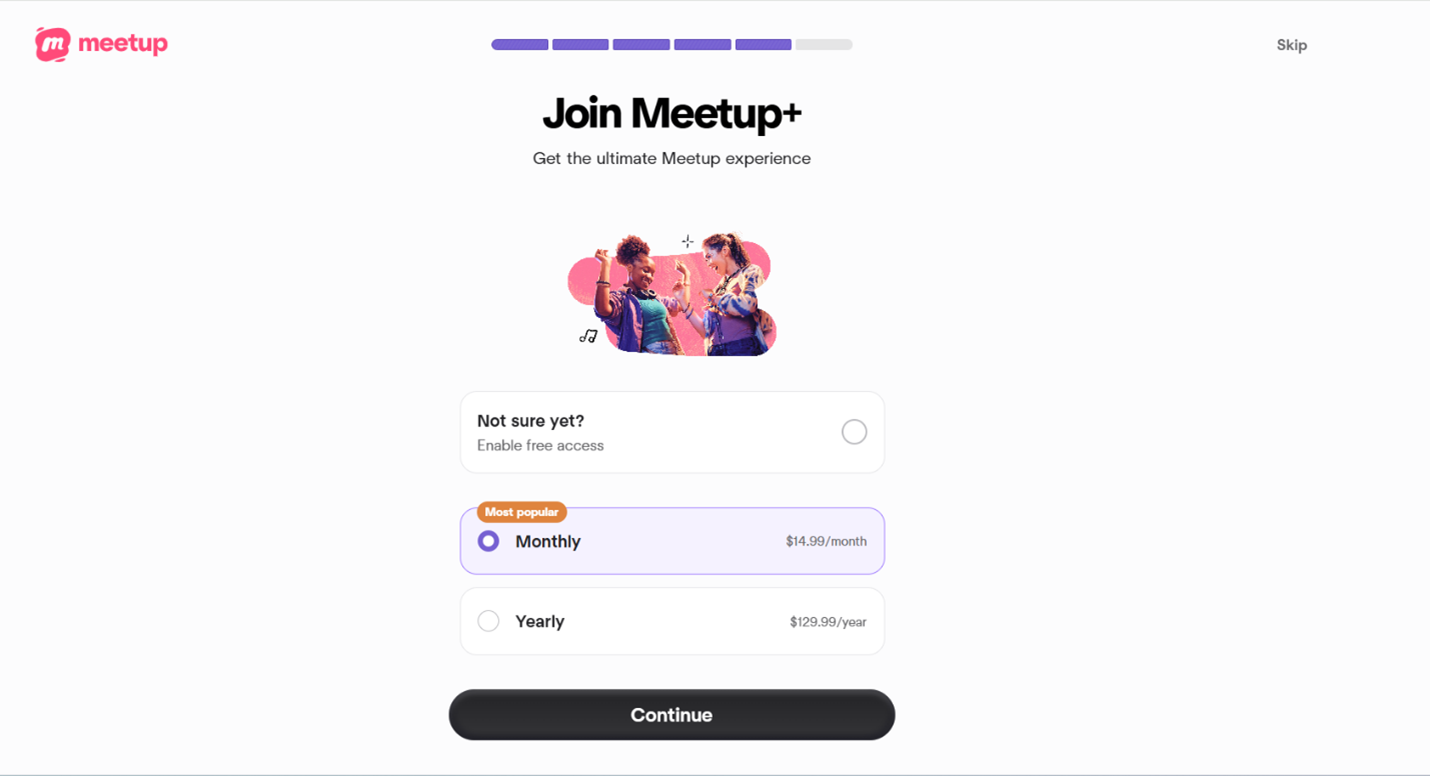
An example of the Meetup+ signup form with attractive women who are unrealistically elated to give away their hard-earned cash.
You may be wondering how this impacts you if you’re just a regular user, especially if you’re fancy and saw the opt-out button and can ignore the constant pokes to give them money. Meetup+ isn’t exactly new. It started on “International Friendship Day” as Member+ in 2023, switched names in 2024, and ramped to whatever unavoidable monstrosity it is now through 2025. The advancement of Meetup+ futzed account capacity for non-paying members by limiting or removing the ability to DM people on the app without restriction. It added cut-in-line features for paid tiers, placed advertisements on the website, and hid event details for users who didn’t fork over money, meaning when you go into event descriptions, you’re limited and don’t even know it.
I created a few free dummy accounts to test what being a new free member was like, and I found trying to join Meetup to be a sincerely stupid experience. The first thing I noticed was the lack of validating factors needed to create an account (more on why this is important later). Then Meetup demanded I join groups upon entry and select keywords from their existing list to assign them. I said I was interested in technology and books and got added to an entrepreneurship group, only tangentially related to technology, and a Christian moms meetup with a quietly horrifying AI group photo with baby limbs on adults, children with distorted facial features, and maternal/child flesh conjoining.

Excuse me for saying this, but y’all are made of nightmares.
I was also prompted to pay for the opportunity to be there multiple times as I explored the site. When I RSVPed to an event, I had to scroll through a carousel of ads for insurance and other products to finish the process.
I created another dummy account in a guest browser to see what would happen if I changed my keyword selection and found that even when I made myself out to be a pothead looking for a good time, Houston Christian Moms still slithered into my groups automatically, as though their tentacle-like extra fingers were inescapable lurs.
I’m presuming this predisposition to bad algorhythmic results was because the organizers have opted into the higher-tier organizer Pro plans and were prioritized in putrefied funnels. Doing random searches for groups seemed to indicate pro-business groups that charged for participation showed up in searches before relevant results in these unpaid accounts. The surprising thing was that I could search the same keywords in my paid account, and I got legitimate results.
A blatant example was when I searched knitting in an unpaid account and got girl boss, lady mastermind, and lean-in group results rather than anything related to yarn on the first page of results. I’m fairly certain Bending Spoons, the venture capitalist organization that currently owns Meetup, knows that people who are looking for knitting groups want to actually knit with people instead of plunking $50 for a meeting with a thought leader, but they don’t care because good results don’t get them paid. Normal people with free accounts aren’t giving them cash, so fuck ‘em, I guess; see if we can get them to buy stuff from the organizers who do pay up, so they’ll stick around.
I am not behind the curtain, so I cannot state with any certainty what fuckery and manipulation is actually happening here. One could argue that because Meetup hadn’t gotten any data on the new accounts, if I’d stuck around, it would have gotten better at tailoring results. But I’m not buying it. It certainly looks like if you’re trying to find groups, you are either fed to the top-paying organizers or you have to pay to access functional search results for free communities. If you don’t agree, please educate me how on how “rich dad cashflow club” and legal weed equals an interest in Houston Christian moms. Remember, I didn’t create that longtail keyword. That came from Meetup’s list of options.

Well, I’m certainly safe around your devoutly raised Christian kids.
Even if you’re thinking about starting a group as an organizer in their free tier, which comes with a ton of limitations already, be aware that even if you’re not paying in money, the cost seems to be your visibility.
This led me to dig into our metrics. Even though I had a paid organizer plan, I wasn’t paying for the highest tier Pro plan. What I found was that our engagement had dropped by 70% across all my groups in six months, and this was plausible considering my experience with the free accounts. Searching for writing groups in my dummy accounts did reveal Shut Up & Write, a national organization that clearly had paid up for the Pro plan but not my sci-fi group with over twenty years’ worth of history and a 4.6-star rating from over five hundred reviews and not my eight-year-old group that also had a 4.6-star rating from over three hundred reviews. This is no shade to Shut Up & Write; they’re an excellent organization, just more writing on the wall.
Looking at engagement, a few frequent flyers were clearly still with, but most of our group members had likely seen what seemed like an inescapable paywall and decided to back away. The makeup of the holdouts made sense because they had a long history on the website and were less inclined to leave a known entity they’d relied on for years. It’s heartbreaking, though, knowing there are those out there who had taken the Meetup+ noise as rejection and stopped coming. These were our baby millennial and younger crowd, especially our Gen Z members, who weren’t going to pay attention to Meetup’s noise because it wasn’t worth the hassle. This wasn’t a reflection of our group activities as our active in-person members mostly range from 25 to 40; the youth is simply not coming from Meetup anymore.
This brings me to another issue. Late last year, I had my identity stolen by someone trying to convince authors to give them money to be part of my weekly programming. An author was suspicious and went looking for my real contact information and then forwarded me the offender’s emails. The only reasonable place my details could have been lifted were from Meetup. How do I know that? Because they used my Meetup picture in the signature. When I’d created my group back in early 2018, Meetup had the option to pull my Facebook profile picture, and I had never bothered to change it to anything else. That image included a very time-specific banner.
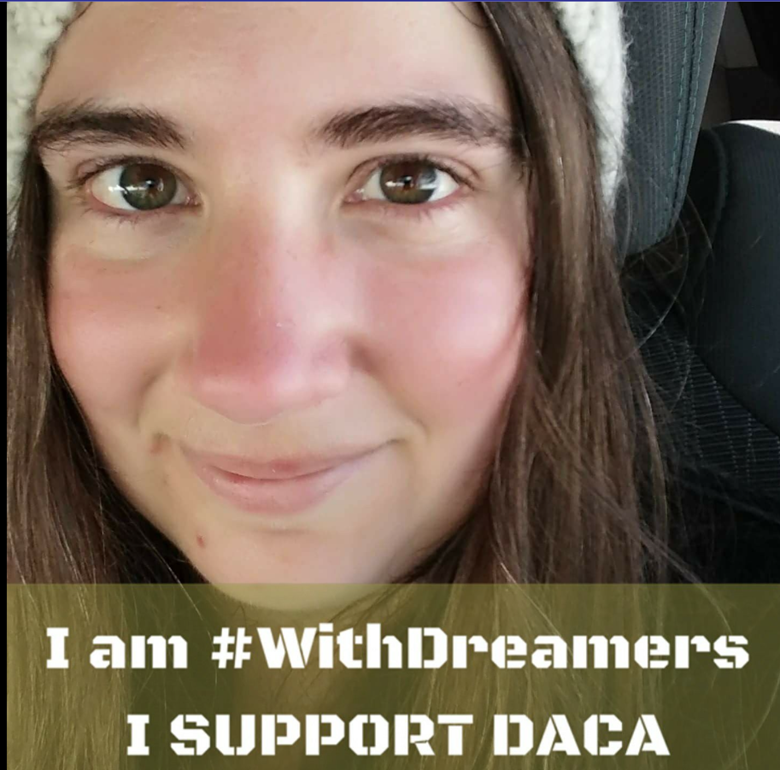
For obvious reasons, it would have been pretty easy to track where this image showed up on the internet even if the identity thief hadn’t also used direct verbiage off my Meetup account in their email.
I reported the theft to the appropriate federal outlets and untrustworthy email registries, emailed the addy where the spam emails originated directly to tell them to knock it the fuck off, sent notices to members not to be fooled, apologized and helped the scammer’s targets who had reached out to me to also make their own reports, and alerted Meetup.
Meetup’s support basically said this was not their problem because the identity theft manifested off their site even though the content had clearly come from on it. Granted, they’ve purged old accounts and gotten better at blocking the ever-present “Free MacBook if you click here” comments that popped up incessantly throughout 2025, but those have been replaced with recurrent “Your event is not live. Click this Meetup link to dispute reports” direct messages that have haunted me throughout 2026, so the spam game is still alive and well. My experience with dealing with security issues on a site that displays your location, your picture if you add it, your name, and your interests left me underwhelmed.
All this to say, we (the Tomeworks team and I) have decided to cease using Meetup. There are some great niche sites like Aftergame and Peanut for specific interests, but there’s not anything specific to writers that I’ve found. Honestly, the general alternatives also suck. Most that looked the best to me are European and don’t have a user base (yet) stateside. We settled on Heylo, but it too looks like it caters to a mostly paying crowd and likely intentionally inhibits searchability for those who don’t pay. We’re still faithfully using Eventbrite, but Bending Spoons has purchased them too, so I’m waiting for that to go down too at this point. However, we’ve also started using Substack to keep engaging our existing community members. It’s a lot, but since Meetup had ceased to be functionally useful anyway, we don’t really have a choice but to try new things.
Fun fact though, Meetup allows non-paying members to start groups, but an established group cannot be handed to a non-paying organizer, which means my groups, the one I inherited that was founded in Meetup’s infancy back in 2004 and the one that is fully of my own making from 2018, have gone into a limbo space where someone can purchase ownership . If they do, they receive the benefit of a now majority-unengaged membership, but they could potentially build something out of our few holdouts.
If no one is willing to shell out funds, Meetup will kill the groups and take all that history with them. They even ask you if you’re sure you want to let your history go when you’re cancelling your organizer membership. They know the site is a foundation and origin space for your communities, and there’s an emotional drive to keep that alive, so they are happy to hostage negotiate with your longevity.
Staying on a plague ship that provides bad actors access to your information, appears to sell your participation to higher payers and hide the connections you’re actually seeking, and takes three hundred hot dollars out of my pocket helps no one, especially not those seeking out connections who swiftly come across a paywall and abandon course.
It begs the question though: If the group leaves its birthplace, is it really the same group? It’s a weird Ship of Theseus situation. For the sci-fi group, leadership changed multiple times, our meeting spaces moved from venue to venue, and member contributions and attendance ebb and flow. The original organizers and members from twenty-ish years ago no longer run it. The majority of the members from pre-COVID times no longer make meetings. So, is it the same group if we sever the last tether to its birthplace?
I’ve wrestled with this a little bit, but my answer is undoubtedly yes. For both groups, we create communities out of faceless populations, and those key elements have not changed, regardless of the channels we call out through the void on.
Pivoting is part of survival, but our goals are still the same: Help authors learn, find community, and make space for connections to happen. If you are seeking these things, we hope you can find us. We’re still out here, just not on Meetup.